
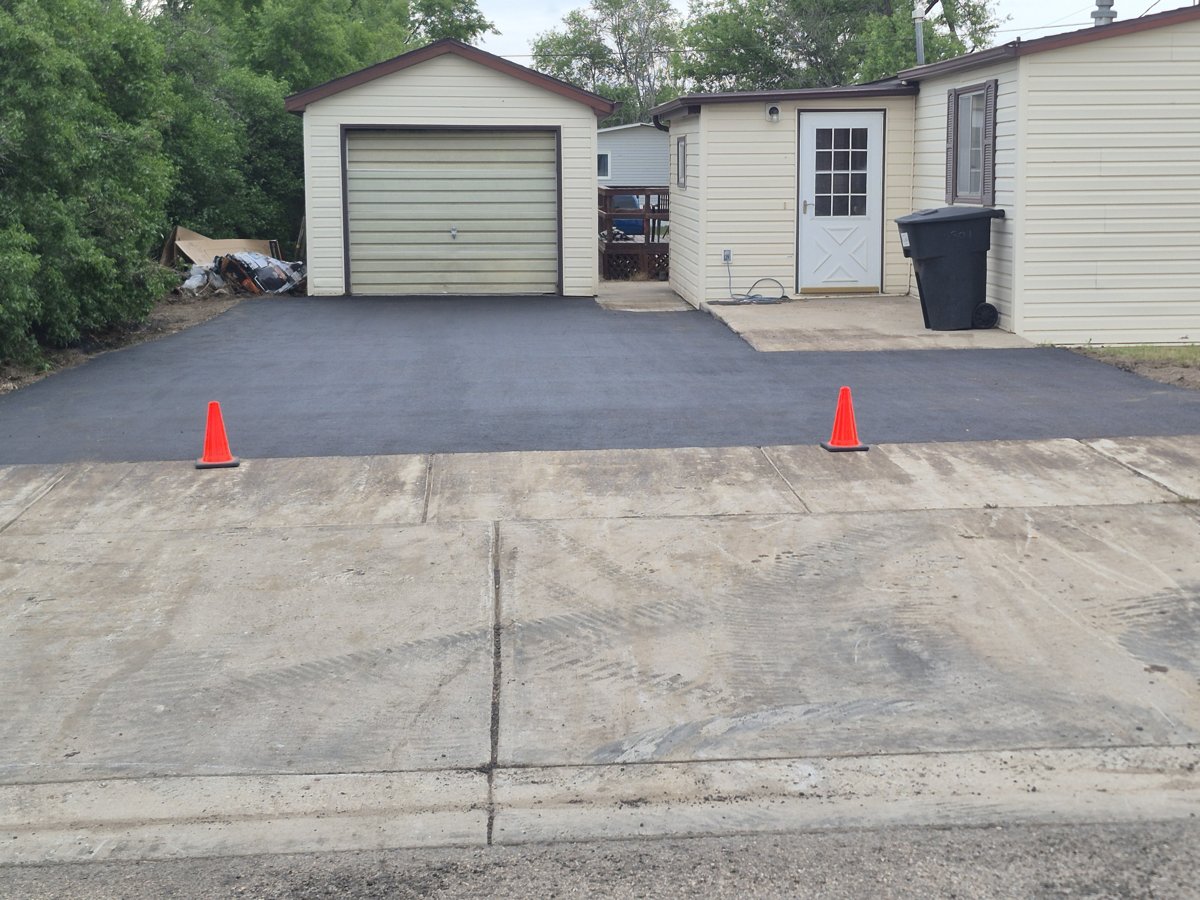
Every spring we get the same question from homeowners around Williston: should I put in asphalt or concrete? Both can make a good driveway. But out here, where the ground freezes hard and thaws muddy every year, the differences matter more than they would somewhere with a mild climate. Here is how the two actually compare.
Freeze-thaw is the real test
Northwest North Dakota does not have one winter. It has dozens of freeze-thaw cycles, where water gets into the ground, freezes, expands, and lifts whatever is sitting on top. A driveway here has to live with that movement for decades.
Asphalt is flexible. It bends a little with the ground instead of fighting it, which is why it tends to handle frost heave without cracking apart. Concrete is rigid. When the ground moves under a concrete slab, the slab cannot flex, so it cracks, and once a crack opens, water gets in and the freeze-thaw cycle widens it. Control joints help, but they do not eliminate the problem.
Cost up front and over time
Asphalt almost always costs less to install than concrete, sometimes significantly less for the same area. For a lot of homeowners that is the deciding factor on its own.
Over the long run, the math gets closer, because asphalt needs maintenance: a sealcoat every few years and the occasional crack fill to keep water out. The upside is that asphalt maintenance is cheap and keeps the surface in good shape. Concrete needs less routine upkeep, but when it does fail, repairs are harder, more visible, and more expensive. A patched concrete slab never really blends back in. A patched and resealed asphalt driveway looks like new.
Speed and getting back to using it
Asphalt installs fast. Once the base work is done, most residential driveways are paved in a day or two, and you are driving on the new surface within a few days. Concrete has to cure, and you are typically looking at a week or more before you can park on it, longer before it reaches full strength.
In a climate with a short build window, that speed is not just a convenience. It means we can fit your driveway into the season before the weather closes it out.
Salt, plows, and daily wear
Winter maintenance is rough on driveways. Road salt and de-icers are hard on concrete over time, and snowplow and shovel edges can chip a concrete surface. Asphalt shrugs most of that off, and its dark surface actually helps melt snow and ice a little faster on a sunny day.
So which would we put in?
For most driveways in and around Williston, we lean asphalt. It costs less, it flexes with our ground instead of cracking against it, it installs fast, and when it does need attention, the fix is simple and affordable. Concrete has its place, especially where someone wants a specific look or has a particular use in mind, and we will tell you honestly if your project is one of those.
The bigger factor than asphalt versus concrete, honestly, is what goes underneath. A cheap driveway of either material on a bad base will fail. A properly graded, compacted base is what makes a driveway last out here.
If you are weighing a new driveway this year, give us a call and we will walk your site, talk through the options, and give you a straight estimate.